

Jesus did not preach or act in secret.
He taught in synagogues, on hillsides, and in the Temple courts. He did it in front of thousands. He fed crowds. He argued with the most powerful religious men in Jerusalem in public, where everyone could hear. And when it finally came to a head, it ended in front of the whole city. His march to Calvary and His brutal execution upon the Roman cross were witnessed by massive crowds. In the weeks after His crucifixion, hundreds of eyewitnesses saw Him alive.
The last chapter left the skeptic with one honest option: the claim that the story grew in the retelling. That a carpenter turned rabbi became a god over decades of embellishment. This chapter is about whether that theory holds. It doesn’t.
The Cross
Nobody seriously disputes that Jesus was crucified on the cross. Not the atheist historians, not the Jewish scholars, not the secular academics who write about Him for a living. The Roman historian Tacitus, certainly no friend of Christians, wrote that their founder, Christus, was executed under Pontius Pilate during the reign of Tiberius. The Jewish historian Josephus records the same. Even scholars who think later copyists potentially added to Josephus’s passage accept its core premise: Pilate had Him crucified. These are hostile or neutral sources with no reason to prop up or embellish the story.
Crucifixion itself was designed to be public. Rome put men on crosses beside the road so everyone walking into the city would see what happened to people who crossed the Empire. Jesus died in daylight, outside the gates of Jerusalem during Passover, when the city was packed with pilgrims. Nothing about His death was hidden.
The Empty Tomb
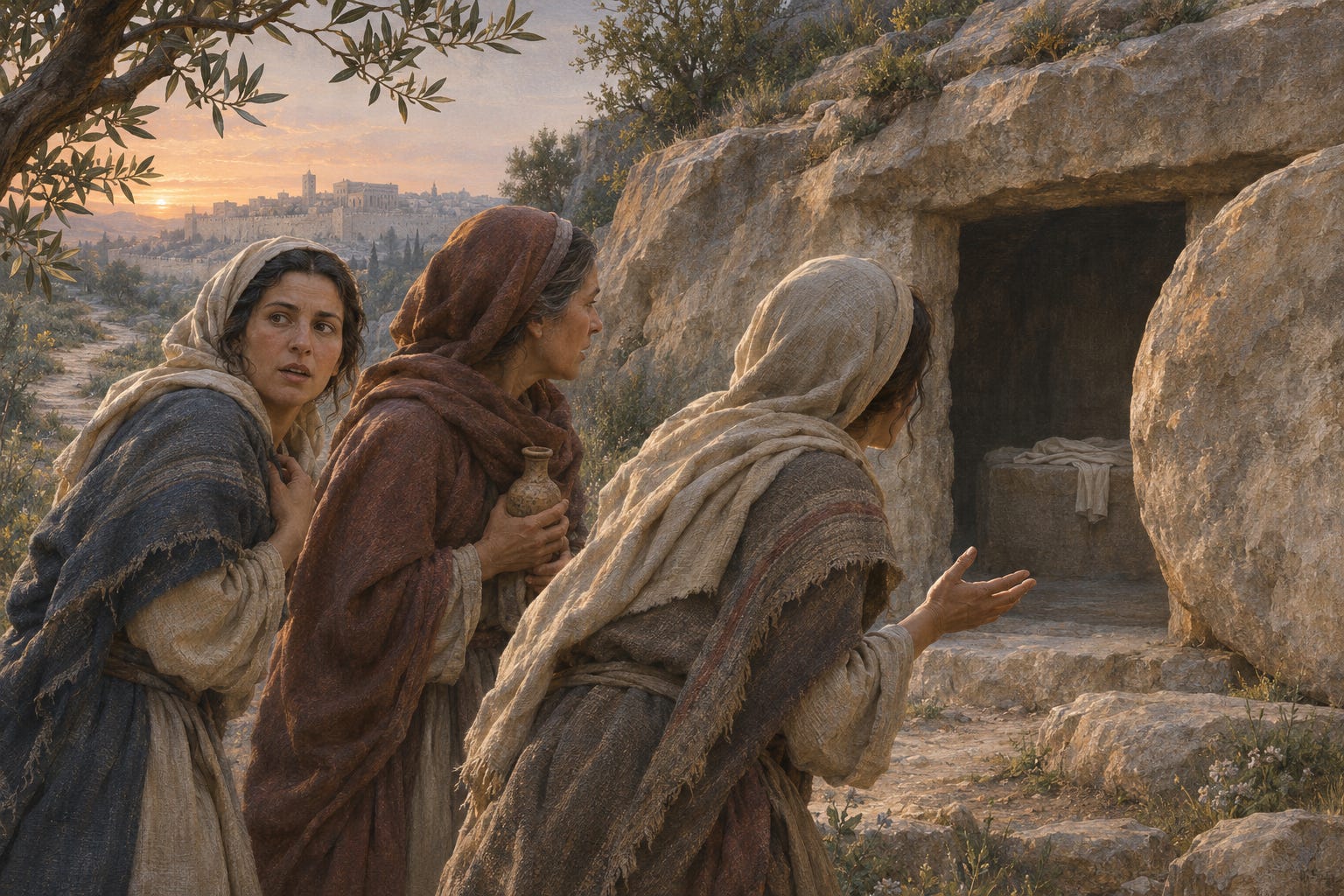
Three days later, the tomb was empty. And the first people to find it were women.
That detail matters more than many may realize. In first-century Judea, rightly or wrongly, a woman’s testimony carried little weight. If you were inventing a resurrection story to convince people, you wouldn’t make women your star witnesses. You’d pick Peter, or John, or a respected member of the council. The Gospels name the women anyway, because that’s what happened. Historians call this the criterion of embarrassment. People typically don’t invent details that are likely to hurt their own case.
Next, let’s look at what the enemies of the early Church said. They didn’t claim the body was still in the tomb. They instead claimed the disciples stole it (Matthew 28:11-15). And that charge didn’t just live in Matthew’s Gospel. Around 155 AD, Justin Martyr told a Jewish opponent that his people had sent men “throughout all the world” to say that “his disciples stole him by night from the tomb” (Dialogue with Trypho 108). Tertullian reports the same charge around 200 AD (De Spectaculis 30). More than a century later, the story was still that the body was stolen. Never that it was still there.
The authorities, who had every motive and resource to kill the movement in its cradle, never actually produced a body. All they had to theoretically do was walk a few hundred yards and point. They couldn’t, because the tomb was empty. Their own story concedes the tomb was empty.
The apostles preached the resurrection in Jerusalem, the very same city where it happened, to the very same people who watched Him die on the cross. You don’t launch a conspiratorial hoax in the one place on earth where it’s easiest to disprove and likely to meet the most resistance.
The Appearances
The claim that the story grew over time then runs straight into the Apostle Paul.
Around 55 AD, Paul wrote to the church at Corinth and passed along something he had “received” (1 Corinthians 15:3-7): that Christ died for our sins, was buried, was raised on the third day, and appeared to Peter, then to the Twelve, then to “more than five hundred brethren at one time, most of whom are still alive, though some have fallen asleep,” then to James, then to all the apostles.
Most of whom are still alive. Paul is telling his readers the witnesses are available. Go ask them yourselves directly.
Scholars across the spectrum, including skeptics, date that creed to within just a few years of the crucifixion. Paul went to Jerusalem about three years after his conversion and spent fifteen days with Peter and met James (Galatians 1:18-19). That's most likely where he received the creed, straight from the men who were there. So the claim of a bodily resurrection, with live named witnesses, goes back not decades but a handful of years. There was no time for a legend to grow. The claim and evidence were there from the start.
The Skeptics Who Changed Sides
Two names on Paul’s list should stop any skeptic cold.
The first is James, the brother of Jesus. During Jesus’ ministry, His own brothers did not believe in Him (John 7:5). James thought his brother was wrong, maybe even out of His mind. Then something changed him. Paul says the risen Christ appeared to him. James went on to lead the church in Jerusalem, and around 62 AD, according to Josephus, he was stoned to death for his troubles. What does it take to make a man go from forsaking to worshiping his own brother as God, and then die for that belief?
The second is Paul himself. He wasn’t a follower or disciple who got his hopes up. He was a persecutor. He hunted Christians, dragged them out of their homes, and stood by approving while Stephen was stoned. Then he claimed he met the risen Christ on the road to Damascus. Paul spent the rest of his life being beaten, whipped, shipwrecked, and imprisoned in the name of that which he used to hunt. Rome eventually took his head.
The easy explanations don’t cover these two. James and Paul weren’t grieving disciples seeing what they wanted to see. They were a skeptic and an enemy, turned worshipers and apostles.
Why They Died
The men who saw the risen Christ wrote about it, and what they did next shows they meant it. The deaths of Peter and James son of Zebedee are among the best attested: James was put to the sword by Herod (Acts 12:2), and Peter was crucified in Rome under Nero, according to sources going back to the first century. Paul and James the brother of Jesus, witnesses outside the Twelve, died in similar ways. The tradition of the early Church holds that every one of the Apostles but John died a martyr. And there is not one account, anywhere, of any of them taking it back.
People do not die for a lie they know is a lie.
A person might die for a mistaken religious belief they inherited. But a group of sane men will never systematically choose stoning, the sword, and crucifixion to defend a hoax they cooked up themselves. That distinction is everything. The apostles didn’t inherit this claim from someone else. They were the source of it. They saw it in living color. If it was a lie, they knew it was a lie, because they were the very ones who made it up. And they stuck to it anyway. One at a time, across different cities and different decades, with no one beside them to hold the line and every reason to break in the final moments at the end.
They had nothing to gain on this earth and everything to lose. No money, no power, no comfortable retirement. Just prison, the lash, and the executioner.
My experience in cases with multiple suspects is that a conspiracy rarely holds up under pressure. You separate them, you question them, and someone invariably flips on their co-conspirators. Nobody wants to take the fall for a story they know is false; they’ll cut a deal to save themselves. Chuck Colson, who went to prison for Watergate, made this point about his own case. The most powerful men in the country couldn’t keep their cover-up together once prison was on the table. Not execution. Prison.
Twelve fishermen and tax collectors facing crucifixion stuck to their stories for decades. Not a single one flipped. Not one sold the others out for his life. They went to their deaths because they knew with absolute certainty that they had seen the risen Son of God.
The Last Excuse
The skeptic has one move left. Maybe they weren’t lying. Maybe they were just sincerely wrong. Grief, hallucination, visions.
It still doesn’t fit. Start with Paul’s list of observers. Hallucinations are private. They happen in one mind at a time. They don’t appear to five hundred people at once, or to different groups in different places over forty days, eating fish and inviting a doubter to put his hand in the wound. They don’t convert a skeptical brother or an enemy who was actively hunting the movement.
And hallucinations don’t empty tombs. If the disciples were truly just seeing things, the body would still be lying in Jerusalem. The authorities would have produced it. They couldn’t. Instead they accused the disciples of stealing it.
Every alternative explanation solves one piece of the evidence while simultaneously breaking another. Only one explanation covers the empty tomb, the appearances, the converted skeptics, and the martyrs at the same time: He is risen.
Those Who Came After
There’s a difference between the apostles and the martyrs who came after them. The later martyrs died for what they believed. The apostles died for what they saw. The apostles are the evidence. The martyrs are proof that the evidence kept working, century after century. In the Colosseum, in Japan, in Uganda, in Iraq last decade. Men and women who had never seen Him walked to their deaths singing, because the thing the apostles saw was still alive.
The Verdict
So, we go back to the question from the first chapter. Is the witness credible?
His death is confirmed by His enemies. His tomb was empty, and His enemies admitted it. The claim of His resurrection goes back to within a few years of the event, with named witnesses who invited scrutiny. His own skeptical brother and His worst persecutor both switched sides because of what they saw. The men who were in a position to categorically know whether it was a lie died horrific deaths one by one rather than take it back.
A conspiracy breaks the moment it actually costs something. This one cost everything, and it never broke.
I find that the witness is credible.
He is risen. Christ is Lord.